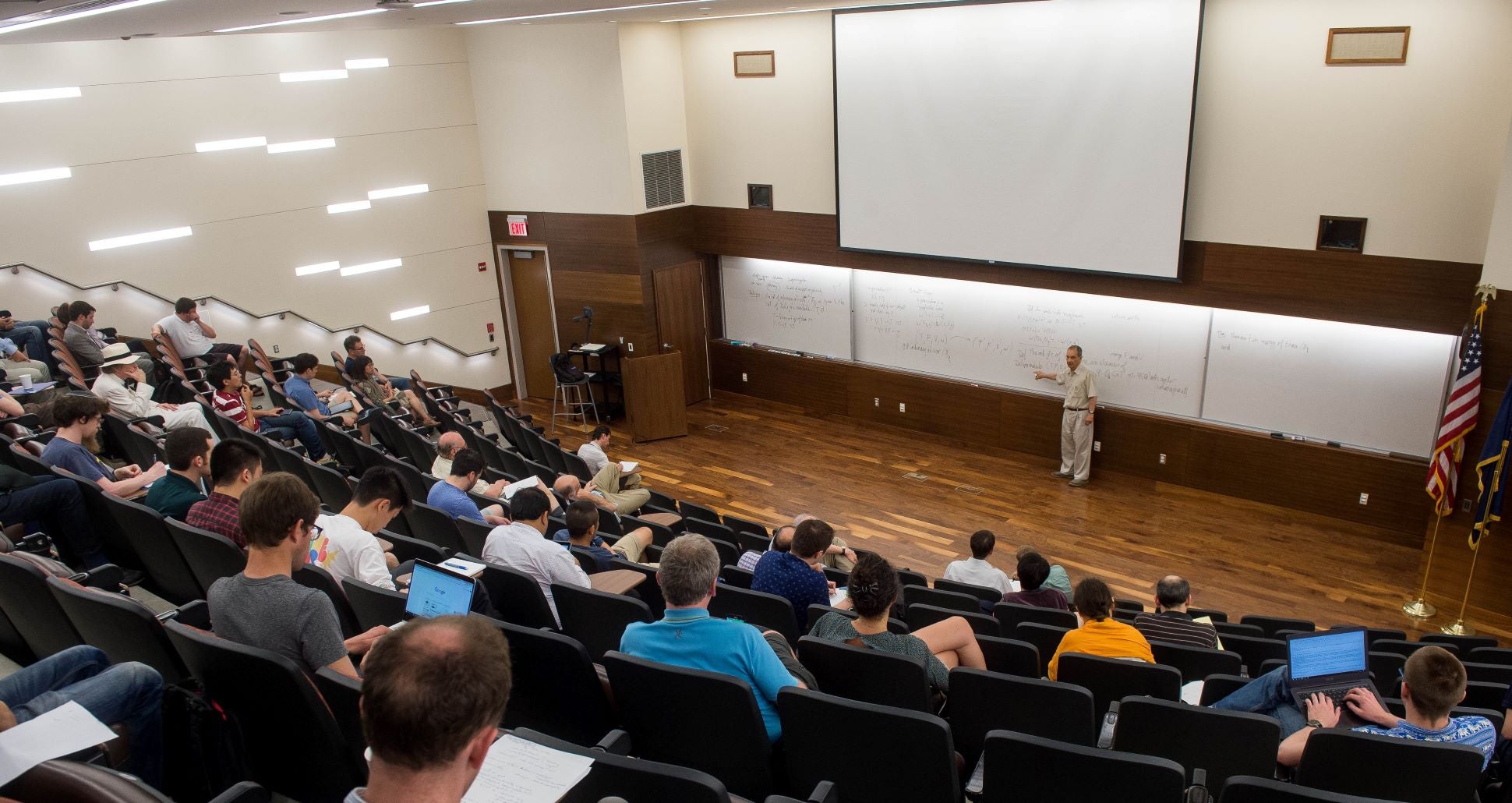
Department members engage in cutting-edge research on a wide variety of topics in mathematics and its applications. Topics continually evolve to reflect emerging interests and developments, but can roughly grouped into the following areas.
Algebra, Combinatorics, and Geometry
Algebra, combinatorics, and geometry are areas of very active research at the University of Pittsburgh.
Analysis and Partial Differential Equations
The research of the analysis group covers functional analysis, harmonic analysis, several complex variables, partial differential equations, and analysis on metric and Carnot-Caratheodory spaces.
Applied Analysis
The department is a leader in the analysis of systems of nonlinear differential equations and dynamical systems that arise in modeling a variety of physical phenomena. They include problems in biology, chemistry, phase transitions, fluid flow, flame propagation, diffusion processes, and pattern formation in nonlinear stochastic partial differential equations.
Mathematical Biology
The Mathematical Biology research group uses mathematical modeling, analysis, and data-driven discovery to understand biological processes. Its members investigate complex biological systems spanning neuroscience, ecology, disease dynamics, molecular and cellular biology, and immunology using tools from nonlinear dynamics, applied mathematics, computation, and network science.
Financial Mathematics, Machine Learning and Optimization
Research on Financial Mathematics, Machine Learning and Optimization revolves around data, uncertainty, optimization, and decision making. Common themes in our work include probabilistic and statistical techniques and high-dimensional analysis. On the machine learning side, we focus on understanding neural networks (approximation theory, generalization to new data and implicit or explicit regularization, stochastic optimization/training) and topics in generative, scientific and geometric machine learning. Research in financial mathematics concerns such topics as optimal stopping, stochastic control theory, and forward and backward stochastic differential equations with applications to finance.
Numerical Analysis and Scientific Computing
The diversity of this group is reflected in its research interests: numerical analysis of partial differential equations, adaptive methods for scientific computing, computational methods of fluid dynamics and turbulence, numerical solution of nonlinear problems arising from porous media flow and transport, optimal control, and simulation of stochastic reaction diffusion systems.
Topology and Differential Geometry
Research in analytic topology continues in the broad area of generalized metric spaces. This group studies relativity theory and differential geometry, with emphasis on twistor methods, as well as geometric aspects of low-dimensional topology.