Workshop on Mathematical Analysis and Machine Learning
Over the weekend of November 22 and 23, the Department of Mathematics hosted the Workshop on Mathematical Analysis and Machine Learning. Twelve speakers gave presentations relating classical ideas from optimization, optimal transport, the calculus of variations and function spaces to novel applications in machine learning and data science. A reception and poster session for the seventy registered participants were held on Saturday evening. This workshop was made possible by the generous support of the Mathematics Research Center at the University Pittsburgh, the administrative support of the staff of the Department of Mathematics, and the graduate student volunteers who provided logistic support during the event. The organizer Stephan Wojtowytsch expresses his gratitude to everyone who helped make the event a success.
Workshop on Harmonic Analysis and Partial Differential Equations
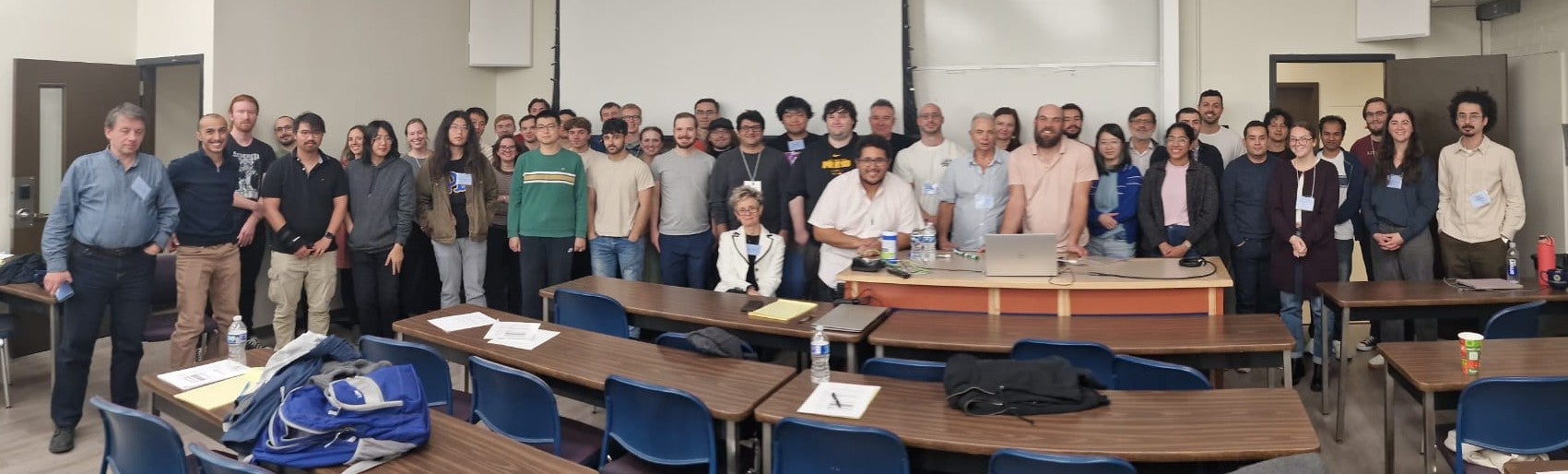
Over the days of November 14 through November 16, the Department of Mathematics at the University of Pittsburgh hosted the Workshop on Harmonic Analysis and Partial Differential Equations. The workshop, which began with the colloquium talk of the department on Friday afternoon, brought together 14 invited speakers, 19 early-career poster presenters, and over 50 participants from the United States and Europe to discuss the state-of-the-art research at the intersections of harmonic analysis, elliptic and parabolic partial differential equations, and geometric measure theory.
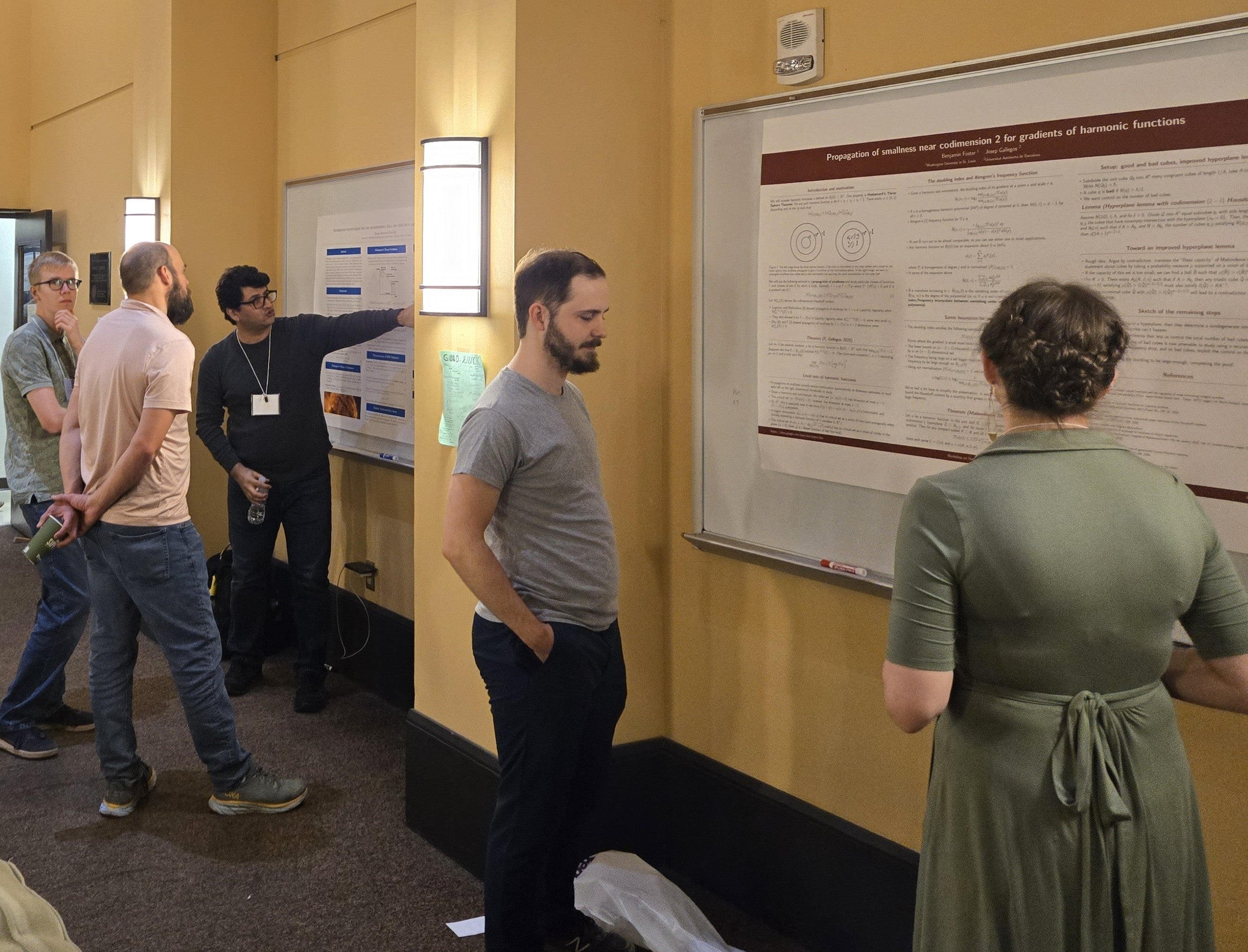
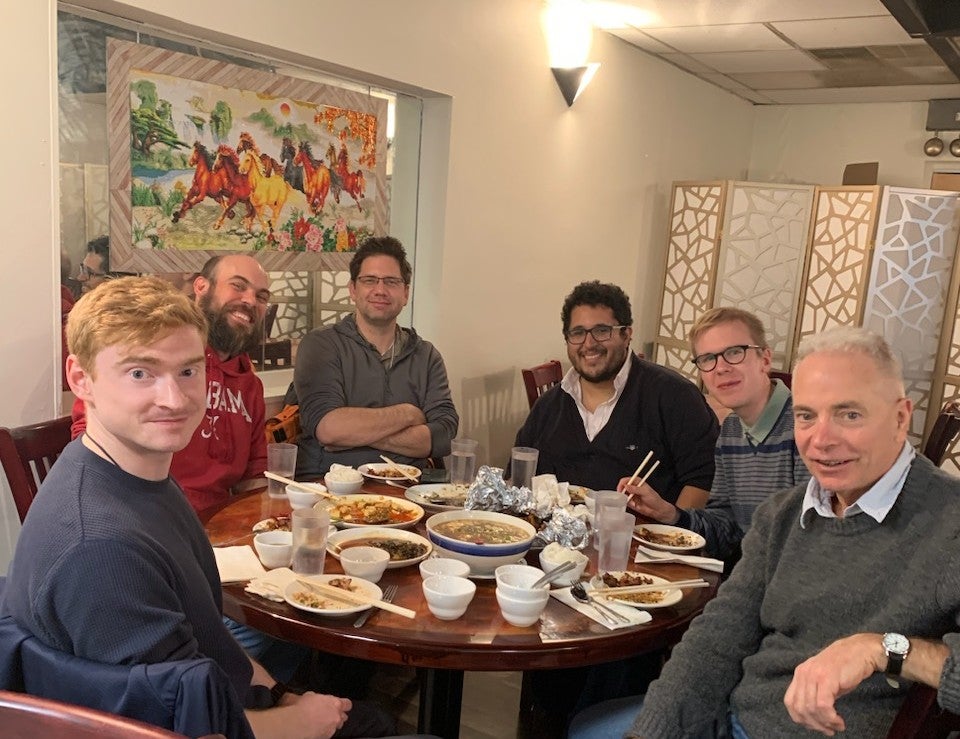
On Saturday evening, the poster session was carried out along the hallways of the 7th floor of Thackeray Hall, with contributions from students across several US institutions, including several of our Pitt graduate students, Wayne State, Kent State, Brown, Baylor, Alabama, Missouri, Washington, Columbia, Washington U. at St. Louis, Purdue, and Illinois at Chicago. The organizers Bruno Poggi and Armin Schikorra thank the department, the department's staff, and the Mathematics Research Center for their financial and logistical support in making this a successful event with substantial scientific interactions.
Alumni Career Panel

At the department’s October 31 colloquium, four Pitt math PhD alumni returned for a Q&A-style career panel: Elise Villela (A&S‘19G) of Google, Mark Fincher (A&S‘22G) of BNY Mellon, Victor DeCario (A&S‘19G) of the Naval Nuclear Laboratory, and Roxana Popescu (A&S‘14G, ‘18G) of the University of Pittsburgh. The panel focused on preparing for careers during the PhD, with discussion shaped largely by audience questions. Topics included practical programming skills across software development, financial modeling, and scientific computing, as well as the less technical skills developed during graduate training that proved useful in industry. With some light faculty heckling mixed in, the group also discussed the use of AI language models and modern computational tools in their work. The panel concluded with remarks on the transition out of a PhD, including differences between industry and academic paths and considerations for both domestic and international students.
Actuarial Career Fair

Gamma Iota Sigma, the actuarial club, hosted its annual Actuarial Career Fair on September 30th, bringing together 12 companies from the insurance, consulting, and financial sectors to connect with students seeking internships and full-time opportunities. As part of the club’s mission to support professional development and connect students with industry opportunities, the fair provided both morning interviews for pre-selected candidates and afternoon booth-style networking for all attendees.
Around 40 students participated, engaging with recruiters about internships, full-time roles, exam support, and career paths. Employers noted strong preparation and professionalism, and many initiated follow-up interview plans. The event continues to strengthen the club’s relationships with employer partners while giving actuarial students meaningful exposure to the industry. The event is organized by the board, led by its President, Emily Rod, and Vice President of Industry Relations, Megan Miller.
The Edmund R. Michalik Distinguished Lecture Series in the Mathematical Sciences
This annual intellectual highlight commemorates Edmund R. Michalik’s long history with the University of Pittsburgh and the Department of Mathematics. He received his BA in education from Pitt in 1937 and went on to receive his MS in mathematics in 1940. After he graduated, Michalik joined the Navy to serve during WWII. The day after he was discharged in 1946, he met his future wife, Martha. He came back to teach at Pitt until 1951. Over the next few years Michalik worked for a variety of organizations, including the Army, Atlantic Research Corporation and the Department of Mathematics at the Mellon Institute, where he was the head of applied mathematics. In 1957 he worked for PPG as the head of the applied mathematics, and later as the senior engineer and head of computer research, when he retired in 1980. Throughout this time Michalik volunteered his time and taught as an adjunct professor in the Department of Mathematics. He was dedicated to the study of mathematics.
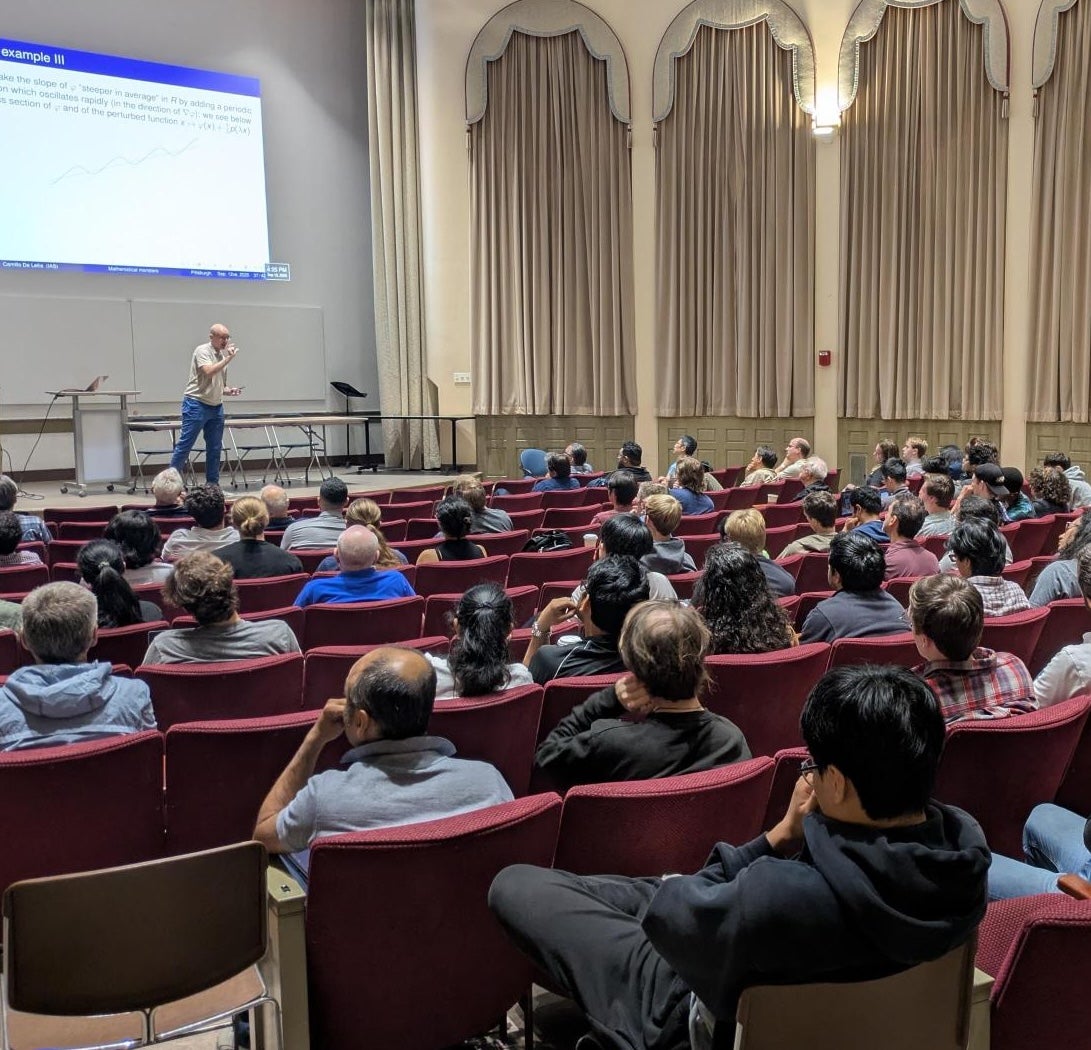

This year's Michalik lecture took place on September 12th at the Frick Fine Arts building featuring speaker Camillo De Lellis, IBM von Neumann Professor at the Department of Mathematics of the Institute for Advanced Study. Dr. De Lellis, a geometric analyst, has broad expertise in the calculus of variations, geometric measure theory, and fluid dynamics. Using modern tools and innovative approaches, De Lellis has contributed to central problems in analysis and geometry, resulting in the creation of a transparent proof of regularity and opening new lines of inquiry for geometric analysts to explore. The talk was very well attended and the audience enjoyed a reception afterwards where students had the opportunity to speak with Dr. De Lellis.
Girls Summer Math Camp

The second installment of the "Girls Summer Math Camp", piloted in 2024, took place in the Department of Mathematics during the week of July 28 - August 1, 2025 and it has been a great success. Organized by professors Marta Lewicka and Sabrina Streipert, the Camp 2025 hosted 18 female high school students from the Greater Pittsburgh area, aged 15-17. Students gained insights into the different mathematical areas thanks to the mini-courses delivered by professors: Evgeni Trofimov (Foundations and Logic), Roxana Popescu (Number Theory), Chengcheng Huang (Math Neuroscience) and Marta Lewicka (Math Analysis). They each gave three hours of engaging lectures and formulated lists of projects for students to work on, supervised by graduate and post-graduate students: Anna Thomas, Nanda Nechingal Raghunathan, Kayla Kraeuter, Zhuojun Yu, Rahnuma Islam and Akshara Vincent.
Students also participated in other activities, including the Levy Lab tour in the Department of Physics, hosted by prof. Jeremy Levy and Chandralekha Singh who provided a very well received talk about Quantum Physics. Students visited the Open Lab at Hillman Library, where Molly Anne Ritter led a thoughtful and fun activity focused on the introduction to the Maker Movement. Guest lecturers included prof. Carl-Wang Erickson and Anna Thomas giving an insight into their research area and prof. Jason Deblois, presenting the Pitt Undergraduate Program in Mathematics and answering many questions from the participants.
On the final day of the Camp, students delivered short talks based on their work during the week, focusing on the resolution of their chosen project they have been working on. The quality of the students’ final presentations was impressively high. Every student gave a presentation and some students wanted to present twice. Jim Griffin and Summer Haston from Dietrich School of Arts and Sciences attended the talks and surprised the students with a sweet snack.
On the exit questionnaire, 12 students chose “Strongly Agree” in response to “I would recommend the Girls Math Camp to a friend” and the remaining 6 chose “Agree”. Likewise, the camp received uniformly strongest positive responses to questions like “I learned a lot from the lectures / projects / lab visits”.
The Girls Summer Math Camp's great success would not have been possible without the aforementioned faculty and students, as well as the dedication from staff members. The organizers are indebted to Linda Yurasits and Michael Giazzoni from College in High School Program, who helped advertise the Camp and recruit top students. Jessica Hohman from the Math Department provided an invaluable support and was involved in every aspect of planning and executing the Camp’s organization: reserving classrooms, ordering lunches, snacks and supplies, meeting students in the parking lot and bringing them to the Camp venues, accompanying tours and lab visits, communicating with parents and watching over students during the breaks. Another “thank you” goes to Cheyenne Rhone, who spent every lunch break with the students; playing ice-breaking math games and working on and presenting the posters of female mathematicians. Additionally, Juanita DelVecchio and Krista West supervised the morning snack breaks.
The department hopes to continue organizing the Girls Summer Math Camp as an annual event providing a unique insight into different areas of mathematics for female high school students.
Pittsburgh Mathematical Horizons Lecture Series
In mid‐March, our Department of Mathematics proudly hosted Oxford-based Fields Medalist James A. Maynard for a two-day event marking the inaugural edition of the Pittsburgh Mathematical Horizons Lecture Series, made possible by the generous support of the Benter Foundation.
Day One – A Deep Dive into Prime Mysteries
On March 20, a joint Mathematical Colloquium was organized in collaboration with Carnegie Mellon University. Targeted toward a mathematical audience, the session saw over 200 math enthusiasts and experts—with such high attendance that latecomers had to stand. In his talk, “Primes and the Riemann Hypothesis,” Maynard offered an accessible exploration of one of mathematics’ greatest unsolved problems. He explained that although the Riemann Hypothesis remains unproven, many of its consequences for the distribution of prime numbers can be established under milder conditions—if any potential counterexamples are sufficiently rare. His presentation also highlighted recent collaborative breakthroughs with Larry Guth, which have significantly advanced our understanding of these exceptional cases.
Day Two – Bridging Pure Mathematics and Everyday Life
The following day, the focus shifted to engaging a wider audience at the inaugural Pittsburgh Mathematical Horizons Lecture, held in the historic Frick Fine Arts Building. This 20th-century venue, known for its elegant architecture and rich artistic heritage, provided a fitting setting for discussions on age-old number theoretic questions. The public lecture was opened by Dean Leibovich, a physicist by training, and moderated by Carl Wang-Erickson. Over 200 attendees—from undergraduates and high school students to senior community members—gathered to hear Maynard address the intriguing question: “How often do two prime numbers differ by exactly 2?” In tackling what is known as the twin prime conjecture, he eloquently connected these deep mathematical ideas to practical applications, such as the security systems that underpin modern internet communications.
Progress
A unifying theme throughout both days was the exciting, incremental progress made in addressing monumental challenges like the Riemann Hypothesis and the twin prime conjecture. While complete solutions still elude us, the advancements of the last two decades—bolstered by Maynard’s own pioneering contributions—demonstrate remarkable strides toward overcoming these obstacles. It is precisely this groundbreaking work that earned him the Fields Medal, an honor widely regarded as equivalent to winning a Nobel Prize in mathematics.
Beyond the Lectures
In addition to his presentations, James A. Maynard interacted with graduate students, postdoctoral researchers, and faculty over lunches and dinners. His approachable demeanor and readiness to engage in lively discussion left an enduring impact on all who attended. We extend our heartfelt thanks to James A. Maynard for sharing his expertise and passion, making this event an unforgettable celebration of mathematical innovation.